
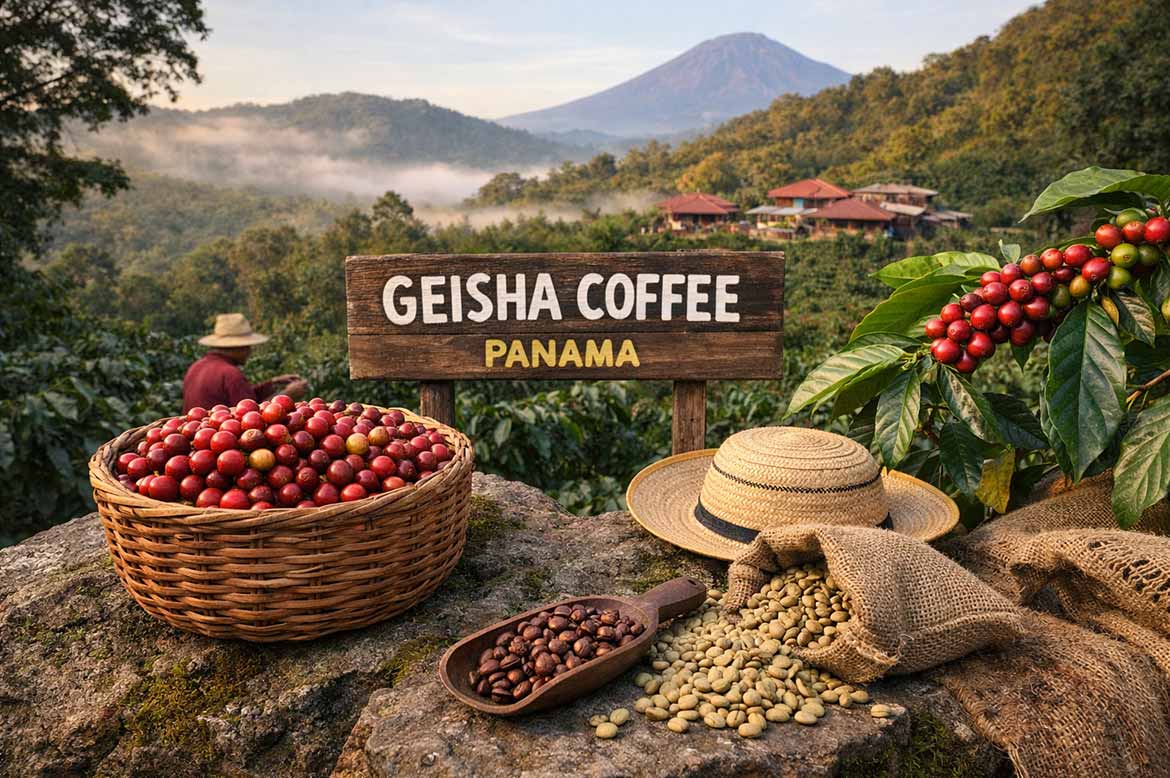
Why Geisha Coffee Beans Are Redefining Luxury in the Coffee World
From Tokyo to New York, connoisseurs are trading in their prized Blue Mountain beans for something even more exclusive: Geisha coffee beans. Once considered the gold standard, Jamaica Blue Mountain coffee has now been eclipsed by Geisha in gift-giving and specialty circles, signaling a shift in global coffee prestige.
With prices soaring to several times that of regular beans, this rare varietal has become synonymous with luxury. In fact, Geisha coffee beans often cost three to five times as much as conventional Arabica beans, placing them firmly in the category of coffee indulgence.
But what makes Geisha coffee so special—and is it genuinely worth the hype? Let’s explore the origins, flavor profile, and global rise of Geisha coffee beans, and discover why Panama coffee producers are at the forefront.
What Are Geisha Coffee Beans?
Geisha coffee beans—sometimes spelled “Gesha”—are a rare Arabica coffee varietal. Despite the name, Geisha is not a region but a cultivar believed to originate from the Gori Gesha forest in southwestern Ethiopia, near the Sudanese border.
Unlike widely cultivated Arabica strains, such as Typica or Bourbon, Geisha’s lineage is shrouded in mystery; research suggests it descends from wild Ethiopian coffee trees and was first identified in the 1930s. It was later introduced to Kenya and Tanzania, before spreading to Central America, including Costa Rica and Panama. Initially, Geisha coffee trees were planted alongside other varietals and valued primarily for their resistance to leaf spot disease, rather than for their flavor. The beans were often mixed with different types and overlooked in quality assessments.
Geisha coffee beans are a unique Arabica varietal with Ethiopian roots, prized for their rarity and complexity.
Panama Coffee’s Breakthrough Moment
Geisha remained obscure until the early 2000s, when Panama’s Hacienda La Esmeralda estate uncovered its potential. Owned by the Peterson family, a retired Swedish-American banking family, the farm had long treated coffee as a secondary crop. Geisha trees were planted alongside other varietals, mainly for their resistance to leaf spot disease.
It wasn’t until the late 1990s that the estate shifted its focus to coffee as its primary business, marking a turning point in its agricultural strategy.
That changed in the late 1990s, when a leaf rust outbreak devastated much of the farm—except for a small plot of Geisha trees. Intrigued by their resilience, the family expanded Geisha cultivation to higher elevations, around 1,650 meters (5,413 feet). The result was astonishing: beans with an elegant, tea-like aroma and layered flavors unlike anything else. In 2004, Hacienda La Esmeralda’s Geisha coffee beans won top honors at a global auction, catapulting Panama coffee into the spotlight. Since then, Geisha beans from Panama have consistently won awards at international coffee competitions, further cementing their elite status.
Panama’s high-altitude Geisha beans stunned the coffee world with their flavor, turning a forgotten varietal into a global sensation.
Flavor Profile: Why Geisha Coffee Beans Stand Out
Geisha coffee beans are long and slender, with a flavor profile that’s both delicate and complex. The most distinctive notes include jasmine, rose, and bergamot, with hints of peach, citrus, berries, cream, and caramel. The mouthfeel is smooth and rounded, with high sweetness and vibrant acidity.
These beans are often described as having a “tea-like” elegance, making them ideal for pour-over or filter brewing methods. However, flavor varies depending on origin, altitude, and processing method. Even within the same estate, different plots can yield dramatically different results.
Geisha coffee is now cultivated in regions beyond Panama, including Colombia, Guatemala, Costa Rica, and China’s Yunnan province, though quality and flavor vary significantly based on terroir.
Geisha coffee’s floral aroma and layered sweetness make it one of the most refined and expressive beans available.
Global Expansion and Challenges
Following Panama’s success, Geisha coffee has been cultivated in Colombia, Guatemala, Costa Rica, and even in China’s Yunnan province. But growing Geisha is no easy feat. The plant demands specific climate conditions, high elevation, and meticulous care. Yields are low, and quality varies widely.
Because of these challenges, Geisha beans remain scarce and expensive. Even within a single farm, beans from different plots can command vastly different prices. For example, Hacienda La Esmeralda categorizes its Geisha beans into three labels: Red, Green, and Blue, based on plot quality and participation in auctions. These labels reflect not only the bean’s origin but also its intended market—Red for top-tier auction lots, Green for premium retail, and Blue for broader distribution.
Geisha coffee’s rarity and cultivation demands contribute to its high price and prestige, with quality varying even within the same farm.
Traceability and Precision Farming
To maintain quality and transparency, top producers like Hacienda La Esmeralda use detailed plot-level tracking. Each coffee plot is numbered and named, with records of altitude, soil type, and shade conditions. This allows for precise management and post-harvest traceability.
Such practices are essential for maintaining consistency and building trust with buyers, especially in competitive auctions where single-lot Geisha beans can fetch thousands of dollars per kilogram.
Precision farming and traceability are key to sustaining Geisha coffee’s elite status and ensuring quality control.
Conclusion: A Rare Bean Worth Knowing
Geisha coffee beans have earned their reputation not only for their rarity but also for their extraordinary flavor and resilience. From the forests of Ethiopia to the highlands of Panama, this varietal has traveled far and transformed the global coffee landscape.
Whether you’re a casual drinker or a seasoned cupper, understanding the story behind Geisha coffee beans deepens your appreciation of what’s in your cup. As climate change reshapes agriculture, Panama’s coffee, particularly its Geisha varietals, may hold the key to the future of specialty coffee.
| Measurement | Metric | Imperial |
| Elevation (Geisha plot) | 1,650 m | 5,413 ft |
| Auction prices | US$1,000/kg | US$454/lb |